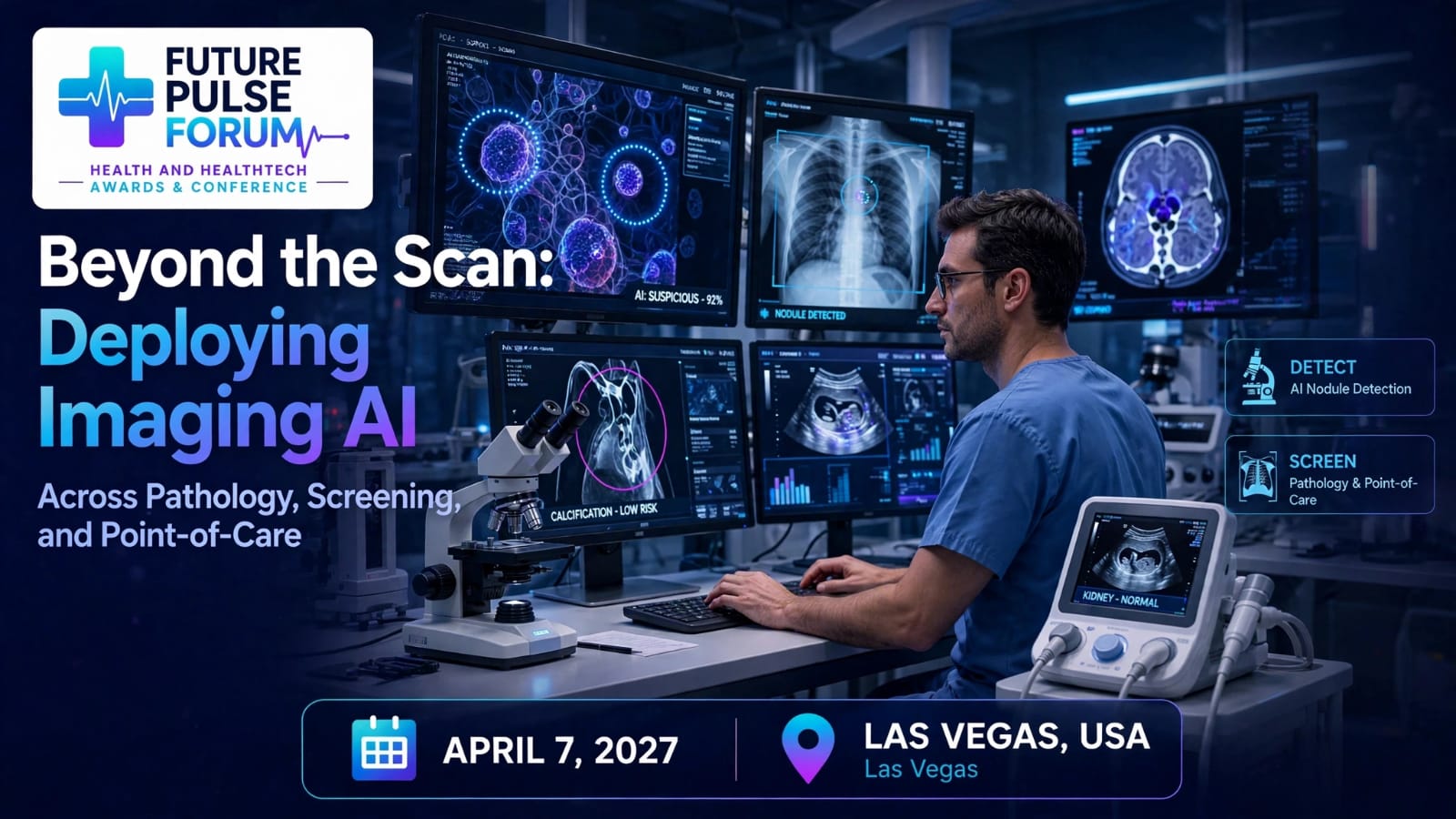
Artificial intelligence is moving medical imaging beyond simple image recognition. As healthcare providers generate growing volumes of digital scans, pathology slides, ultrasound images, and other diagnostic data, AI is increasingly being developed to help clinicians detect abnormalities, prioritize cases, interpret complex images, and support faster clinical decisions.
The next stage of imaging AI will not be defined only by how accurately an algorithm identifies a finding. Its value will depend on how effectively it fits into clinical workflows, supports healthcare professionals, and performs across different patient populations and care environments.
From digital pathology to clinical decision support
Digital pathology is one of the areas where AI has significant potential. Whole-slide images can contain enormous amounts of visual information, creating opportunities for algorithms to identify patterns that may be difficult or time-consuming to assess manually.
AI can assist with tasks such as identifying suspicious regions, classifying tissue patterns, detecting image-quality issues, and supporting disease assessment. Recent research has demonstrated the potential of AI in digital pathology, while also emphasizing the need for stronger clinical evidence, standardized validation, and careful assessment of bias before widespread adoption.
The role of AI is therefore shifting from replacing individual diagnostic tasks toward augmenting the pathologist’s workflow. By directing attention to relevant areas and reducing repetitive analysis, AI could help specialists manage increasing diagnostic workloads while retaining human oversight.
Making screening more intelligent
Screening programs generate another major opportunity for imaging AI. Mammography, CT, retinal imaging, lung imaging, and other modalities can produce large volumes of images that require systematic interpretation.
AI can support screening by identifying suspicious findings, prioritizing examinations, and helping clinicians focus on cases that may require earlier review. In radiology, regulatory frameworks already recognize AI-based software for computer-assisted triage and notification, demonstrating how algorithms can be integrated into workflows without necessarily making the final clinical decision.
The potential impact is particularly significant when earlier detection depends on reviewing large numbers of images. However, performance in controlled research settings does not automatically translate into clinical effectiveness. Differences in scanners, imaging protocols, patient populations, and healthcare environments can affect how an algorithm performs in practice.
Bringing imaging intelligence closer to the patient
Point-of-care imaging represents another important direction. Portable ultrasound, microscopy, camera-based diagnostics, and other compact imaging technologies can bring diagnostic capabilities closer to patients and clinicians.
When AI is integrated into these systems, it can assist with image acquisition, image quality, interpretation, and rapid decision-making. Research into AI-enabled point-of-care ultrasound highlights its potential to support clinicians while also identifying concerns around reliability, trust, training, and implementation—issues that are especially relevant in emergency departments, primary-care settings, rural facilities, and other environments with limited access to specialist expertise.
The challenge is no longer only accuracy
As imaging AI moves toward deployment, accuracy is only one part of the equation. Healthcare organizations must consider whether systems can integrate with existing workflows, communicate results clearly, maintain patient privacy, and perform reliably across different settings.
Transparency is also becoming increasingly important. Clinicians need to understand the intended role and limitations of an AI system rather than treating its output as an unquestionable clinical answer. Recent research on medical AI transparency emphasizes trust among patients, healthcare professionals, developers, and regulators as an important condition for effective deployment.
Regulation is evolving alongside these technologies. The US Food and Drug Administration reported that more than 1,600 AI-enabled medical devices had been authorized for marketing in the United States as of September 2026, illustrating the scale at which AI is entering medical-device development.
From algorithms to integrated care
The future of imaging AI will depend less on isolated algorithms and more on integrated clinical systems. A successful solution may combine image analysis with patient history, laboratory information, clinical observations, and other relevant data to provide more useful decision support.
Instead of viewing AI as a tool that simply reads an image, providers can begin to treat it as part of a connected diagnostic workflow—from image acquisition and quality control to prioritization, interpretation, reporting, and follow-up. The objective is to give clinicians better tools to handle growing diagnostic demands, identify important findings earlier, and make more informed decisions.
As imaging AI expands across pathology, screening, and point-of-care environments, the organizations that gain the greatest value will be those that combine technical capability with clinical validation, responsible governance, workflow design, and continuous monitoring. The future of medical imaging will therefore be about more than what AI can see. It will be about how effectively that intelligence can be translated into safe, timely, and meaningful patient care.
As medical imaging AI moves from research into clinical practice, the focus is shifting toward responsible deployment, workflow integration, and measurable patient impact. Future Pulse Forum brings together healthcare leaders, technology innovators, and industry experts to explore how AI can move beyond the scan and contribute to smarter, more connected healthcare.
Join Future Pulse Forum to explore the technologies, strategies, and partnerships shaping the future of healthcare and health technology.