The world learned a hard lesson during the pandemic: speed matters. When outbreaks emerge, every day counts. When medicines, protective equipment and other critical supplies run short, healthcare systems can struggle to respond. Today, artificial intelligence (AI) is helping public health teams identify potential threats earlier and make healthcare supply chains more responsive during crises.
AI can analyze large and diverse datasets that would be difficult to process manually. These include clinical information, environmental surveillance, public reports and other signals that may reveal emerging health threats. At the same time, AI can help health systems forecast demand, optimize inventory and identify potential supply-chain disruptions before they become critical.
How AI Spots Outbreaks Before They Spread
AI systems can analyze large volumes of data to identify unusual patterns that may signal an emerging outbreak. These data sources can include:
Clinical data: Emergency department visits, symptom reports and laboratory results
Environmental data: Wastewater surveillance, weather patterns and climate-related signals
Digital signals: News reports, public bulletins and other openly available information
Animal and vector data: Reports of disease in livestock, wildlife and disease-carrying vectors
When unusual activity is detected, AI-assisted systems can generate signals for epidemiologists and public health officials to investigate. The goal is not to replace human expertise, but to help experts identify and assess potential threats more quickly.
Real-World Applications
Wastewater Surveillance for Measles
Wastewater surveillance is becoming an additional source of information for monitoring infectious diseases. In Colorado in 2025, Measles virus was detected in wastewater before the first confirmed cases were reported, giving public health authorities an additional early signal to investigate. The CDC has highlighted wastewater surveillance as a complementary approach that can support traditional disease surveillance.
The example shows how environmental data can provide useful signals even before conventional case reporting provides a complete picture.
WHO’s EIOS 2.0
The World Health Organization’s Epidemic Intelligence from Open Sources (EIOS) initiative demonstrates how AI is being integrated into global public-health surveillance.
In October 2025, WHO launched EIOS 2.0 with expanded data sources and AI-powered tools designed to support automated analysis and signal detection. The system analyzes large volumes of publicly available information to help identify potential public-health threats and assess risks in near real time.
WHO reported that the initiative was being used by more than 110 Member States and around 30 organizations and networks.
EIOS illustrates an important role for AI in global health security: helping public health professionals process information at a scale and speed that would be difficult to achieve through manual monitoring alone.
What This Means for Health Systems
Earlier warning: AI-assisted surveillance can help identify unusual patterns and emerging signals earlier.
Smarter resource allocation: Health authorities can use emerging information to help determine where testing, vaccines, personnel and other resources may be needed.
Better situational awareness: Combining multiple data sources can give health teams a broader view of developing health threats.
Faster decision-making: Automated analysis can reduce the time required to identify and investigate potentially important signals.
How AI Keeps Medical Supplies Flowing
During the pandemic, healthcare systems faced shortages of personal protective equipment (PPE), medicines, ventilators and other essential supplies. Sudden changes in demand, manufacturing disruptions, transportation problems and regional outbreaks exposed vulnerabilities across global healthcare supply chains.
AI can help make these systems more responsive by connecting demand signals with inventory, procurement and logistics data.
How AI Helps
Forecasting demand: AI models can analyze historical consumption, seasonal patterns, disease activity and other variables to estimate future demand for medicines and medical supplies.
Optimizing inventory: AI can help organizations determine appropriate stock levels, identify products at risk of shortage and support replenishment decisions.
Monitoring disruptions: AI systems can analyze operational and logistics data to identify potential disruptions involving suppliers, transportation routes or distribution networks.
Supporting resource allocation: During emergencies, data-driven systems can help decision-makers assess competing needs and determine where limited supplies may have the greatest operational impact.
Improving visibility: Integrated dashboards can give supply-chain teams a clearer view of demand, inventory and distribution across different locations.
What This Means for Health Systems
Fewer stockouts: Better demand visibility can help organizations prepare for changes in consumption.
Reduced waste: More accurate forecasting can help limit excess inventory and the expiry of unused supplies.
Greater resilience: Early identification of supply risks can give organizations more time to respond to disruptions.
Faster recovery: AI-assisted planning can support the adjustment of procurement and distribution strategies when conditions change.
The Bigger Picture
AI is becoming an increasingly important component of global health security. Combining outbreak intelligence with more responsive supply-chain planning can help health systems prepare for emerging threats while improving their ability to respond when crises occur.
However, technology alone cannot guarantee better health outcomes. Data quality, interoperability, privacy, cybersecurity, workforce training and ethical governance all influence how effectively AI can be used. Access is also important, particularly for health systems with limited digital infrastructure and analytical capacity.
The objective should therefore be responsible integration: using AI to strengthen public health capabilities while keeping human expertise, accountability and oversight at the center of critical decisions.
What's Next?
As AI tools mature, outbreak surveillance and healthcare supply-chain systems are likely to become more connected. Early signals from disease surveillance could increasingly inform demand forecasts, procurement decisions and distribution planning.
Open and collaborative platforms such as EIOS also demonstrate the potential for AI-assisted public-health intelligence to operate across borders and organizations.
For health leaders, the opportunity is not simply to adopt another technology. It is to build systems that can detect risks earlier, interpret information faster and respond more effectively when health emergencies emerge.
Join the Conversation in Las Vegas
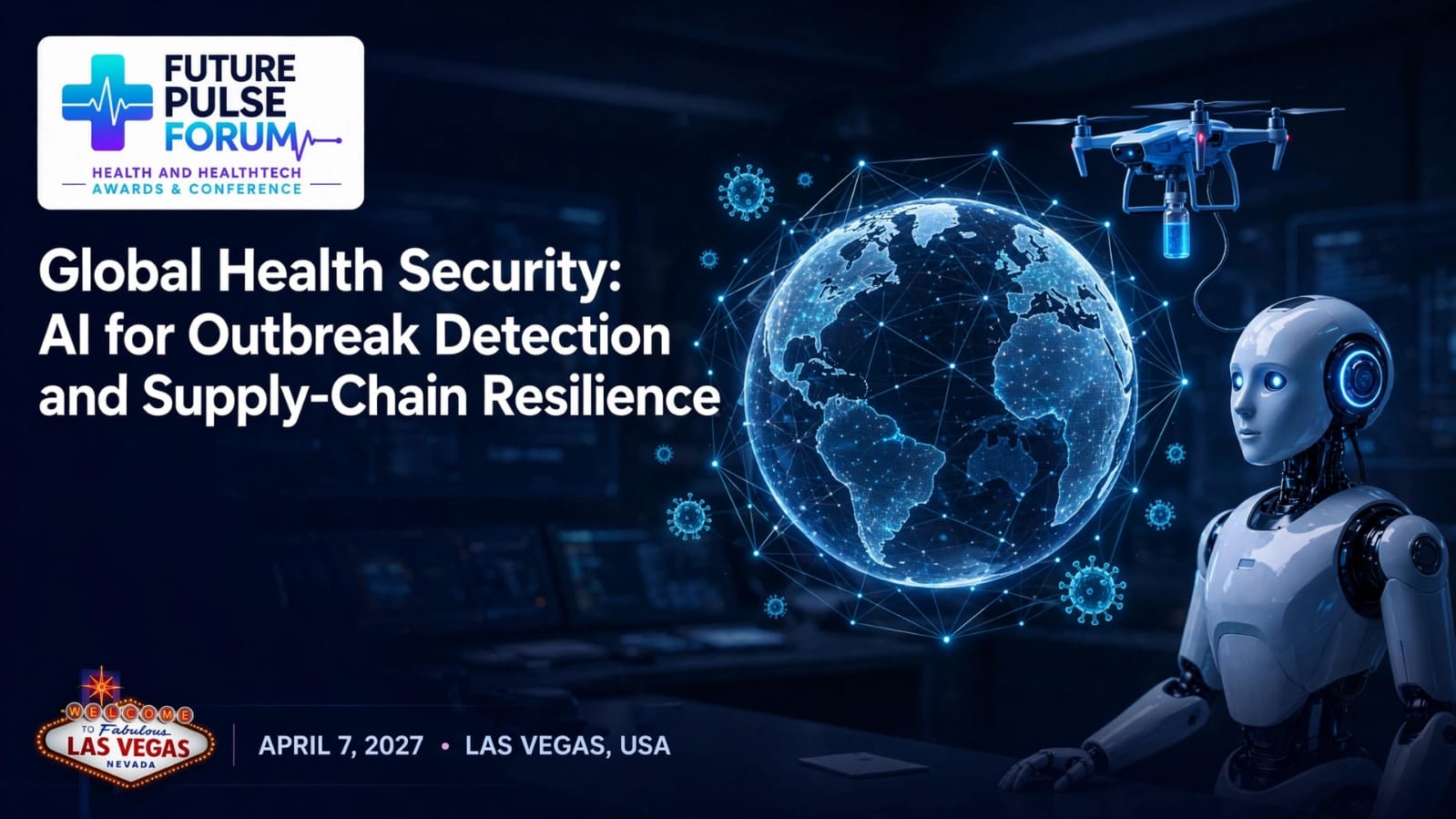
Take the next step at the Future Pulse Forum 2027, taking place on April 7, 2027, in Las Vegas. The one-day executive gathering will bring together healthcare and technology leaders to explore practical approaches to AI adoption, governance, health-system resilience and supply-chain transformation.
Participants will have the opportunity to explore:
•Executive discussions on AI-driven outbreak surveillance and medical logistics
•Case studies on predictive analytics and healthcare operations
•Perspectives from healthcare, technology and supply-chain leaders
•Practical approaches for strengthening organizational resilience
The future of global health security will depend not only on detecting threats earlier, but also on having the systems, people and supply chains ready to respond.