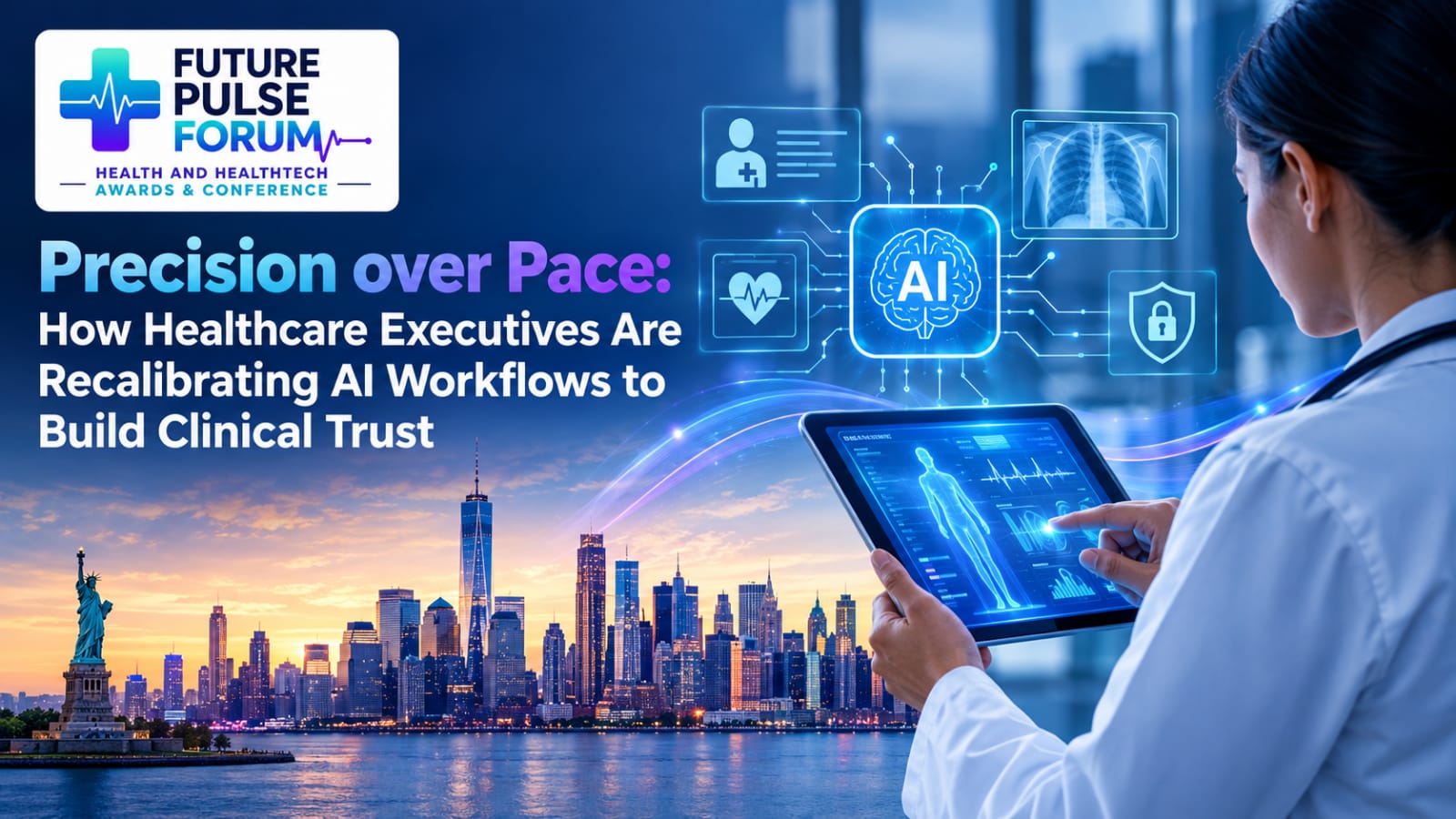
Artificial intelligence is becoming deeply embedded in healthcare, but successful adoption is no longer about deploying more powerful models faster. For healthcare executives, the critical question is how AI fits into clinical workflows without creating new risks, administrative friction, or uncertainty for clinicians and patients.
This is shifting the focus from pace to precision. Instead of asking how quickly an AI tool can be introduced, healthcare leaders are examining where it should be used, how its outputs should be reviewed, and when human judgment must remain central.
The Shift from Speed to Safety
For hospital CEOs, Chief Medical Officers (CMOs), and technology vendors, the reality is clear: a hallucination in a B2B SaaS product costs money, but a hallucination in a clinical setting costs lives.
As autonomous AI agents move closer to direct patient interaction and advanced diagnosis, executives are deliberately slowing deployment timelines. Primary metrics are shifting from speed of adoption to clinical validation. The goal is simple yet complex: building genuine clinical trust.
The Three Pillars of the Recalibration Strategy
Forward-thinking healthcare organizations are focusing on three operational pillars to shift from pace to precision:
Require explainable AI with traceable logic paths: Clinicians are rejecting black box models. Workflows must allow doctors to audit the machine’s reasoning before acting on its recommendations.
Insert mandatory human-in-the-loop check-stops: Instead of end-to-end autonomous tasks, organizations are repositioning AI as a highly competent assistant, with defined points for human validation.
Integrate natively with EHR/FHIR workflows: Trusted AI tools blend into existing Electronic Health Records and FHIR data pipelines, reducing cognitive load rather than disrupting clinical focus.
Governance, Evidence, and Transparency as Workflow
Governance cannot sit separately from implementation. Approval processes, escalation procedures, monitoring, and human oversight need to be built into the workflow itself.
Mayo Clinic illustrates this approach with an executive-led review process in which every clinical AI application is assessed before deployment. The evaluation covers clinical setting, performance, patient safety, workflow integration, privacy and security, training, and lifecycle management. For complex applications affecting time-sensitive decisions, proactive human review remains part of the process.
Clinical trust also depends on understanding what an AI system can and cannot do in real-world conditions. The World Health Organization’s 2026 guidance on AI-related health research calls for stronger ethics review and oversight across the AI lifecycle, with explicit attention to transparency, bias, fairness, accountability, privacy, and potential harms.
For executives, this means evaluating AI beyond headline accuracy figures. Questions around validation, monitoring, explainability, human accountability, and real-world performance must become part of procurement and deployment decisions.
Building a Trusted AI Operating Model
The next phase of healthcare AI will require a disciplined operating model. Leaders must:
•Identify workflows where AI delivers measurable value
•Define who reviews AI-generated outputs and when
•Monitor performance after deployment
•Enable clinicians to report issues or override recommendations
The objective is not to slow innovation but to make it dependable in environments where clinical decisions carry significant consequences. As AI embeds deeper into care, precision—evidenced by robust workflow design, governance, and human oversight—will determine whether adoption translates into lasting clinical value.
Join the Conversation
The future of healthcare AI will depend on more than technological capability. It will require clinical trust, responsible governance, and workflows designed around real-world healthcare needs. Future Pulse Forum – Health & HealthTech Awards & Conference brings together healthcare leaders, technology innovators, and industry experts to explore how AI and emerging technologies are reshaping healthcare delivery.
Join the conversation and explore the ideas shaping the future of health and health technology.