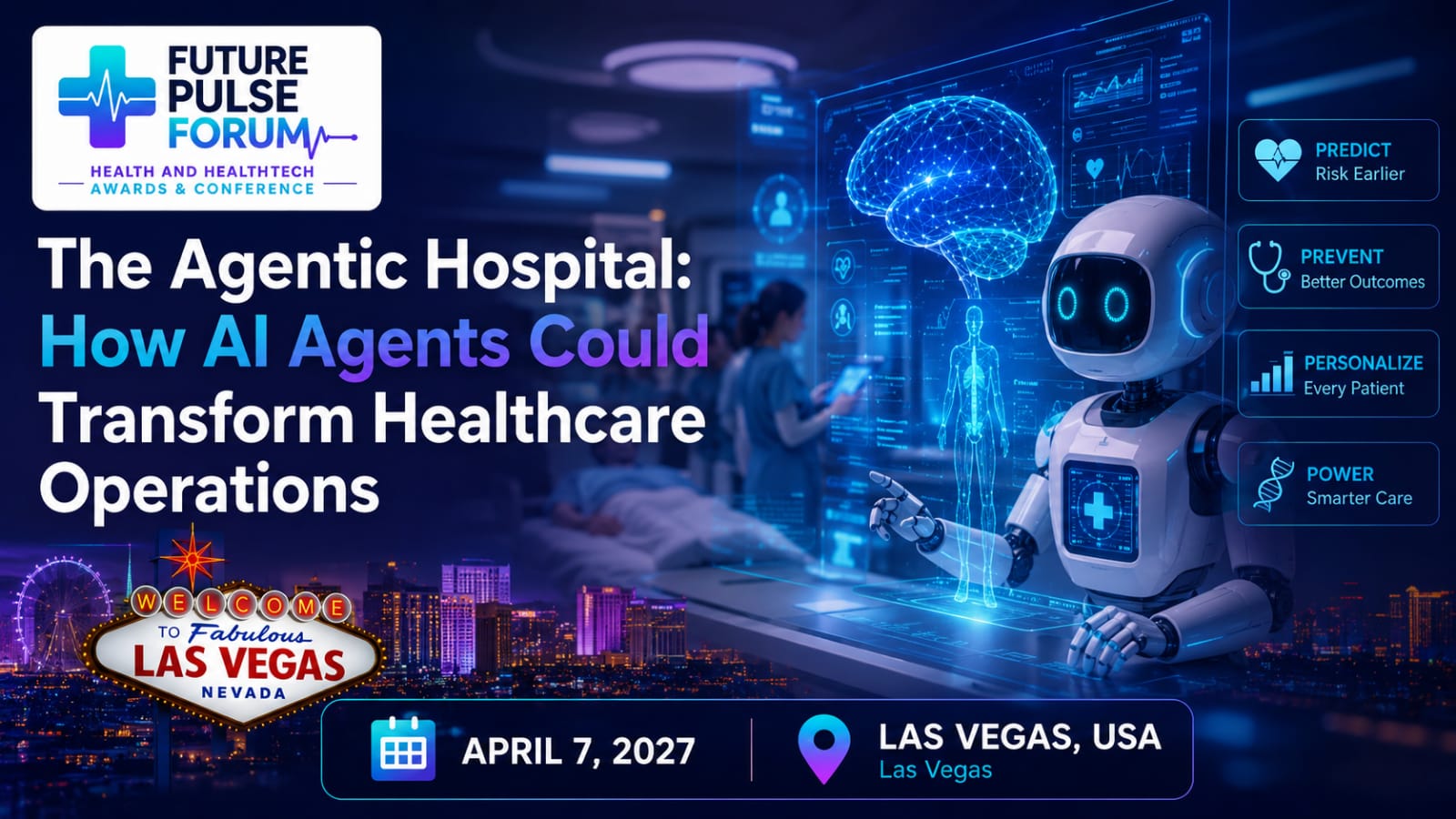
Hospitals are increasingly becoming dynamic, data-driven operating environments where AI can coordinate workflows across clinical, administrative, and operational functions. Agentic AI systems—software that can perceive information, reason through tasks, and execute multi-step actions within defined guardrails—are beginning to reduce wait times, automate routine documentation, and improve capacity utilization in real-world healthcare settings.
What Is an Agentic Hospital?
An agentic hospital uses specialized AI agents to manage routine, high-volume workflows with a degree of autonomy while operating within predefined rules and human oversight. Unlike traditional automation, which generally follows fixed workflows, agentic AI can interpret information, determine the next step, coordinate actions, and hand off tasks across systems such as electronic health records (EHRs), scheduling platforms, contact centers, and revenue-cycle tools.
In practice, this can include:
• Patient access agents that handle inbound calls, schedule appointments, send reminders, and support no-show recovery.
• Clinical documentation agents that draft visit notes, discharge summaries, and prior-authorization narratives for clinician review.
• Operations agents that support bed assignments, operating-room utilization, emergency-department flow, and staffing decisions.
• Revenue-cycle agents that assist with eligibility verification, coding, claims workflows, and denial management.
The potential result is a hospital that operates more like a coordinated, data-driven network—identifying bottlenecks, supporting resource allocation, and allowing clinicians and staff to spend more time on work requiring human judgment.
Tampa General Hospital: Reducing Patient Access Bottlenecks
Context: faced long call wait times, high abandonment rates, and missed appointment opportunities in its contact center.
Intervention: The hospital partnered with Hyro to deploy voice AI agents capable of answering patient calls around the clock, handling routine scheduling and access questions, and routing more complex cases to staff with relevant context.
Outcomes reported after deployment included:
• Call abandonment falling 56%, from 34% to 14.9%
• Average wait time declining 58%, from 6.2 to 2.4 minutes
• Scheduled appointments increasing 21%
The deployment illustrates how an AI-powered patient-access workflow can produce measurable operational improvements while also addressing a common source of patient frustration.
Broader Momentum: Health Systems Scaling Agentic AI
Tampa General is part of a broader movement toward deploying AI agents across healthcare operations. A July 2026 review identified 12 health systems expanding their use of agentic AI, with applications spanning patient access, nursing, pharmacy, IT, and care coordination.
Examples include:
WellSpan Health: Its voice agent Ana handles more than 160,000 patient calls per month and approximately 7,000 conversation hours. The system has also been extended to outbound outreach involving missed imaging appointments, post-discharge follow-ups, and chronic-disease check-ins.
MUSC Health: Its AI agent Emily supports prescription refills, status inquiries, and pharmacy routing through an Epic-integrated platform.
Cincinnati Children's, OhioHealth, and Cleveland Clinic: These health systems have been involved in developing Hippocratic AI’s Nurse Co-Pilot, designed to support tasks such as admission education, patient teaching, and medication-adherence workflows. The company reports that the technology can potentially return 1–4 hours per nurse per shift.
Intermountain Health: The health system has combined conversational AI capabilities with Salesforce Agentforce for Healthcare to automate scheduling, password resets, and patient-access requests, with integration into Epic workflows.
CommonSpirit Health: CommonSpirit has reported approximately 250 active AI tools across more than 150 hospitals, generating more than $100 million in annual value through applications including automated notetaking, call processing, and clinical surveillance. While not all of these tools are agentic, the scale demonstrates the broader acceleration of AI adoption across healthcare.
These deployments show that healthcare AI is moving beyond isolated pilots toward broader operational use. The emerging model is not a single AI system performing every task, but a network of specialized agents working within defined boundaries and connecting workflows across the hospital.
Operational Impact: A Multi-Agent Platform Case
Another case study involving a four-hospital regional health system illustrates the potential of multi-agent orchestration for hospital operations.
The reported results included:
• Emergency Department boarding reduced by 52%
• Operating Room utilization increased from 67% to 81%
• Estimated annual revenue impact of $3.2 million
The platform used multiple AI agents to coordinate areas such as bed flow, surgical scheduling, and discharge planning. The case suggests how coordinated AI workflows could help hospitals unlock existing capacity rather than relying solely on additional physical infrastructure.
Risks and Guardrails
Greater autonomy also introduces greater responsibility. Agentic systems operating across healthcare workflows must be designed with appropriate human oversight, data protections, escalation mechanisms, and auditability.
Important safeguards can include:
• Clinician review and sign-off for clinical documentation, care plans, and other high-impact outputs
• Escalation to qualified staff when cases fall outside predefined parameters
• Clear authorization boundaries defining what an AI agent can and cannot execute
• Audit trails that record agent actions, decisions, and system interactions
• HIPAA-compliant data handling for US deployments, with applicable privacy and data-protection requirements addressed in other jurisdictions
The objective is not to replace clinicians. It is to reduce repetitive, high-volume administrative work and support staff so that human expertise remains focused on complex decisions, patient relationships, and situations requiring clinical judgment.
Future Pulse Forum: Where Healthcare Meets Agentic Innovation
As agentic AI moves from experimentation to real-world healthcare operations, leaders need practical strategies for scaling these systems safely and effectively.
Future Pulse Forum brings together healthcare and technology leaders to explore AI-driven transformation, governance, and the future of healthcare operations.
Join the conversation and discover how agentic AI can shape the next generation of healthcare.